> ## Documentation Index
> Fetch the complete documentation index at: https://elastly.io/docs/llms.txt
> Use this file to discover all available pages before exploring further.
# Guardrails & rules
> The limits every recommended price has to respect, and how they combine.
The margin steps propose a target price. Guardrails are the limits that price has to respect before
Elastly shows it to you. The steps decide where to aim; the guardrails decide the number you actually
get. Every recommendation records which guardrail had the final say, so a held price is never a
mystery.
## The guardrails
Eight limits can shape a final price. All of them are live.
| Guardrail | What it does |
| ----------------------- | -------------------------------------------------------------------------------------- |
| Minimum margin | The price can never fall below cost plus this margin. Every workspace has one. |
| Maximum margin | An optional cap, so a price never runs away above a margin you set. |
| Price floor | A hard money floor for a product, regardless of margin. |
| Price ceiling | A hard money ceiling for a product. |
| MAP compliance | Minimum advertised price. The price never goes below what your brand agreement allows. |
| Max competitor distance | Keeps the price within a set distance of a tracked competitor, above or below. |
| Max change per cycle | Limits how far a price can move from what this customer last paid for this item. |
| Psychological rounding | How the final number is tidied up. |
Price floor, price ceiling, and MAP can come straight from your source as `floorCents`,
`ceilingCents`, and `mapCents`, so a product can carry its own limits in. See
[Field mapping](/docs/field-mapping).
## How they combine
Guardrails do not fight each other. They collapse into one floor and one ceiling, and the strictest
always wins.
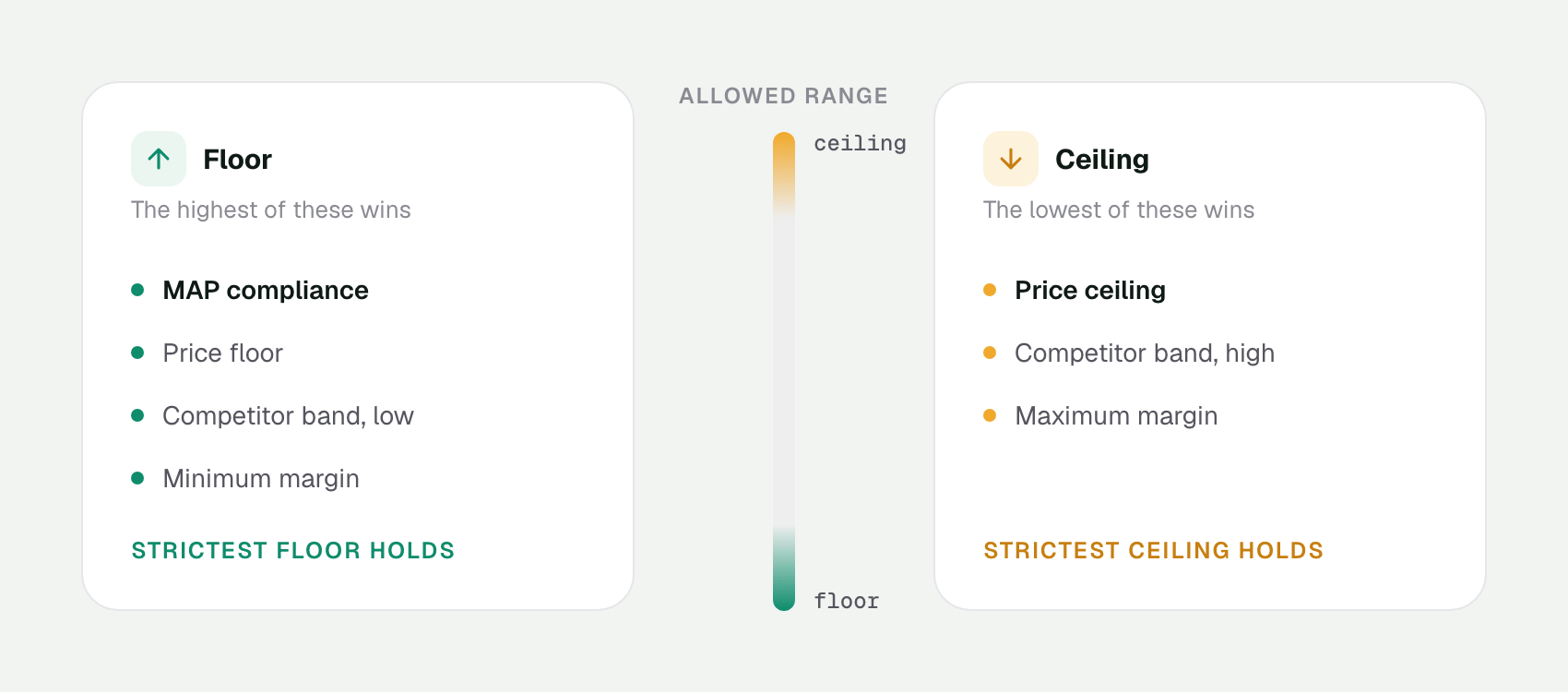 When two limits land on exactly the same number, Elastly names the more specific one as the reason.
MAP is named first, then price floor, then competitor distance, then minimum margin. If MAP and your
margin floor both put the floor at \$12.00, the recommendation says MAP held it, because that is the
one you would want to know about.
## The order they are applied
The target price is pulled inside the effective floor and ceiling.
The price is pulled inside the range allowed by what this customer last paid.
The number is tidied to your rounding style.
The band, the ceiling, and the floor are all re-applied, in that order.
**The floor gets the last word, on purpose.** Rounding runs before the final checks, so a rounding
step can never push a price under your floor or over your ceiling. Anything rounding moves out of
bounds is pulled straight back in.
## Max change per cycle
This is the guardrail people misread most, so it is worth being precise. It does not band the last
**price**. It bands the last **margin**, then applies that band to today's cost. If your cost moved,
the price is allowed to move with it rather than being frozen to an old number.
How wide the band is depends on how stale the price is and how much your cost has moved:
| Ingredient | Default |
| ------------- | -------------------------------------------------------------------- |
| Base | 2pp either side of the last margin. |
| Age | Widens 0.05pp per day since the last purchase, up to a further 10pp. |
| Cost movement | Widens as your cost moves, up to a further 10pp. |
So a price sold yesterday at an unchanged cost barely moves. A price last sold a year ago, on a cost
that has jumped, is allowed to catch up. The bottom of the band is never allowed below your minimum
margin.
## Rounding
Two styles, and you pick one:
Snap every result to `.99`, `.95`, or a whole unit. Best where customers see the price.
Round to sensible steps that grow with the price. The default ladder rounds to the nearest 5c
under $10, the nearest 25c under $100, the nearest $1 under $1,000, and the nearest \$5 above
that. A good fit for B2B pricing, where charm endings look out of place.
## Where they live
Your guardrails are set once in the **Control Center** and apply everywhere. New workspaces start
with sensible defaults rather than an empty, unguarded state, so you are protected from day one.
Strategies inherit them. A strategy can tighten the margin floor, the margin ceiling, rounding, and
the max change for its own products. It can never loosen any of them, and it cannot touch the other
guardrails at all. See [Pricing strategies](/docs/strategies).
**Never a mystery.** Every recommendation carries the guardrail that held it back, if one did,
along with the full list of limits that were checked. A held price always explains itself. See
[Explainability](/docs/explainability).
When two limits land on exactly the same number, Elastly names the more specific one as the reason.
MAP is named first, then price floor, then competitor distance, then minimum margin. If MAP and your
margin floor both put the floor at \$12.00, the recommendation says MAP held it, because that is the
one you would want to know about.
## The order they are applied
The target price is pulled inside the effective floor and ceiling.
The price is pulled inside the range allowed by what this customer last paid.
The number is tidied to your rounding style.
The band, the ceiling, and the floor are all re-applied, in that order.
**The floor gets the last word, on purpose.** Rounding runs before the final checks, so a rounding
step can never push a price under your floor or over your ceiling. Anything rounding moves out of
bounds is pulled straight back in.
## Max change per cycle
This is the guardrail people misread most, so it is worth being precise. It does not band the last
**price**. It bands the last **margin**, then applies that band to today's cost. If your cost moved,
the price is allowed to move with it rather than being frozen to an old number.
How wide the band is depends on how stale the price is and how much your cost has moved:
| Ingredient | Default |
| ------------- | -------------------------------------------------------------------- |
| Base | 2pp either side of the last margin. |
| Age | Widens 0.05pp per day since the last purchase, up to a further 10pp. |
| Cost movement | Widens as your cost moves, up to a further 10pp. |
So a price sold yesterday at an unchanged cost barely moves. A price last sold a year ago, on a cost
that has jumped, is allowed to catch up. The bottom of the band is never allowed below your minimum
margin.
## Rounding
Two styles, and you pick one:
Snap every result to `.99`, `.95`, or a whole unit. Best where customers see the price.
Round to sensible steps that grow with the price. The default ladder rounds to the nearest 5c
under $10, the nearest 25c under $100, the nearest $1 under $1,000, and the nearest \$5 above
that. A good fit for B2B pricing, where charm endings look out of place.
## Where they live
Your guardrails are set once in the **Control Center** and apply everywhere. New workspaces start
with sensible defaults rather than an empty, unguarded state, so you are protected from day one.
Strategies inherit them. A strategy can tighten the margin floor, the margin ceiling, rounding, and
the max change for its own products. It can never loosen any of them, and it cannot touch the other
guardrails at all. See [Pricing strategies](/docs/strategies).
**Never a mystery.** Every recommendation carries the guardrail that held it back, if one did,
along with the full list of limits that were checked. A held price always explains itself. See
[Explainability](/docs/explainability).