> ## Documentation Index
> Fetch the complete documentation index at: https://elastly.io/docs/llms.txt
> Use this file to discover all available pages before exploring further.
# Pricing strategies
> How Elastly builds each price as a readable stack of steps, and how you shape it with strategies.
Elastly builds every price the same way: it starts from your cost and adds margin in named steps.
Add the steps up, apply them to cost, and that is the price. Nothing is a black box, and a strategy
is a way to add your own steps for the products you choose.
Every step is a signed adjustment in percentage points, so the steps simply add up. A bigger order
can pull the margin down at the same time a rising cost is nudging it up. The price reflects the
total, not one factor at a time.
## The order a price is built in
The margins you set. Elastly picks the most specific one that applies.
Signals read from the order and your data, like a rising cost or a large order.
A small correction from what actually sold.
Your own rules, applied on top.
The limits that clamp whatever the steps above produced.
## Your base margins
These are the margins you configure. Category margin is the starting markup over cost; the rest are
signed adjustments on top.
| Margin | Scope | What it does |
| ------------------ | ------------ | ------------------------------------------------ |
| Category margin | Category | Starting markup over cost, per product category. |
| Brand override | Brand | A signed adjustment for a brand. |
| Segment adjustment | Segment | For example, dealer +5pp. |
| Region adjustment | Region | For example, West Africa −6pp. |
| Country adjustment | Country | For example, Saudi Arabia +1.2pp. |
| Payment terms | Credit terms | For example, cash −2pp. |
**The most specific setting wins.** For any one margin, Elastly picks a single value using this
order: an exact value, then category and brand together, then brand, then category, then segment,
then country, then region, and finally your global default. Setting a margin for one category does
not stack with your global default, it replaces it.
## What Elastly derives
These steps come from the order in front of it and the data it has synced. Each is off until you
configure it, and each contributes only when its signal is actually present.
| Step | Moves the margin when |
| ---------------- | ------------------------------------------------------------ |
| Cost trend | Your cost is rising, so your margin doesn't quietly erode. |
| Demand | Demand for the product is picking up or cooling off. |
| Demand response | The product's own response to recent price moves. |
| Volume | The customer buys at a volume that earns a different margin. |
| Order value | The order is large in money terms. |
| Order quantity | The order is large in units. |
| Stock level | Stock is unusually high or low. |
| Stock age | Stock has been sitting, or has just arrived. |
| Delivery urgency | The customer wants it faster. |
## A worked example
Every step is a signed adjustment on cost, and they add up to the target margin. The numbers here are
illustrative.
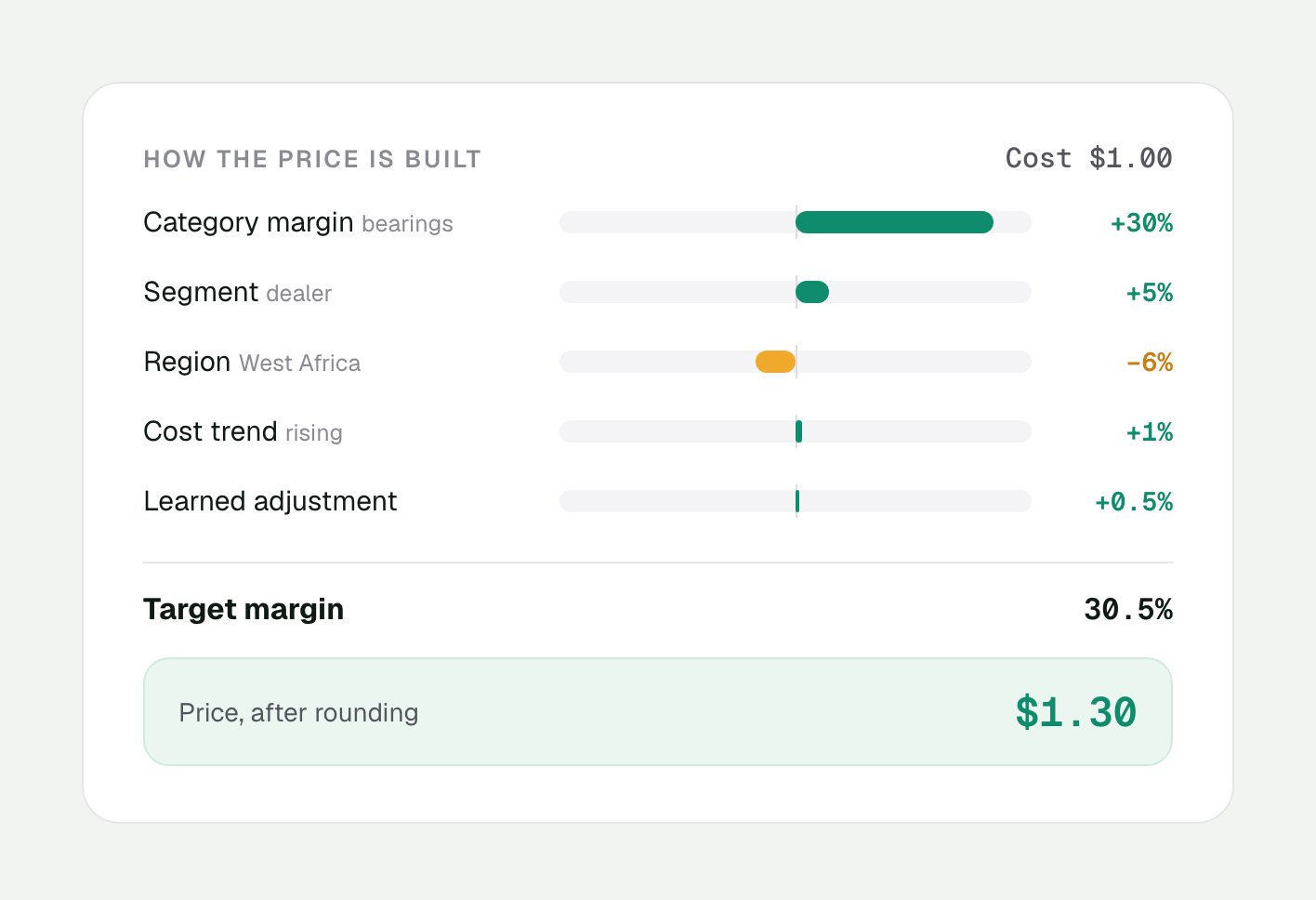 Because a price is a sum of named steps, Elastly can always tell you exactly why a number is what it
is. That is the whole point of the model. See [Explainability](/docs/explainability).
## What a strategy is
A strategy is a rule you add on top to shape pricing for a set of products. It has three parts:
**scope** (which products and customers it covers), **conditions** (when it should act), and an
**action** (what to do).
### Actions
| Action | What it does |
| --------- | -------------------------------------------------- |
| Raise | Add margin. |
| Mark down | Take margin off. |
| Target | Move the price toward a margin you name. |
| Hold | Keep the current price and protect it from moving. |
| Match | Price level with a tracked competitor. |
| Beat | Price under a tracked competitor. |
| Premium | Price above a tracked competitor. |
Match, beat, and premium need a competitor source connected before they can act.
### Conditions
A strategy acts only when its conditions hold. You can test current margin, last margin, order
quantity, payment terms, delivery speed, stock state, days of inventory, price band, whether the
product is a known value item, the gap to a competitor, how many sellers are on it, demand, and
elasticity. You can also test any custom attribute you have mapped.
### Scope
Scope narrows a strategy to the products and customers you mean: brand, price band, price, current
margin, last margin, known value items, channel, region, country, and payment terms, plus your own
mapped attributes.
**A strategy can tighten, never loosen.** A strategy can make four guardrails stricter for its
products: the margin floor, the margin ceiling, rounding, and how far a price may move from its
last one. It can never make any of them looser, and it cannot touch your other guardrails at all.
See [Guardrails & rules](/docs/guardrails).
A strategy adds its own steps on top of the base price. It never throws the price away and starts
over, so a price stays just as readable with a strategy as without one.
## It learns from real sales
When a quote is won or lost, Elastly nudges the margin for that customer and product by a small,
capped amount. One order never swings a price, but thousands steer it.
The steps are deliberately small:
| Rule | Default |
| ------------------- | ------------------------------------------------------------- |
| Step size | 0.30pp per observation. |
| Largest single step | 0.50pp, no matter what the evidence says. |
| Total cap | ±5pp. The learned adjustment can never move a margin further. |
Elastly also keeps track of the highest margin a customer has accepted and the lowest they have
rejected, and holds the learned offset between the two. It squeezes toward what you know rather than
guessing past it.
### It learns at the most specific level it can
Learning is keyed to the narrowest scope with evidence behind it:
1. Customer and item
2. Customer and subcategory
3. Segment and subcategory
4. Segment and category
A brand new customer benefits from what the segment already learned, and a customer you sell to often
gets a correction specific to them.
**A loss only counts as "too expensive" if you could have supplied it.** If the item was out of
stock when the quote was lost, the loss had nothing to do with price, and Elastly ignores it
completely rather than lowering your margin for it.
An adjustment also has to earn its place. Confidence grows with the number of observations, and a
learned offset stays out of the price until there is enough evidence behind it, which is roughly four
observations at the default setting.
## Guardrails always apply
Whatever the steps add up to, the price passes through your guardrails before you ever see it. The
steps set the target; the guardrails decide the final number, and the recommendation tells you which
one had the final say. See [Guardrails & rules](/docs/guardrails).
Because a price is a sum of named steps, Elastly can always tell you exactly why a number is what it
is. That is the whole point of the model. See [Explainability](/docs/explainability).
## What a strategy is
A strategy is a rule you add on top to shape pricing for a set of products. It has three parts:
**scope** (which products and customers it covers), **conditions** (when it should act), and an
**action** (what to do).
### Actions
| Action | What it does |
| --------- | -------------------------------------------------- |
| Raise | Add margin. |
| Mark down | Take margin off. |
| Target | Move the price toward a margin you name. |
| Hold | Keep the current price and protect it from moving. |
| Match | Price level with a tracked competitor. |
| Beat | Price under a tracked competitor. |
| Premium | Price above a tracked competitor. |
Match, beat, and premium need a competitor source connected before they can act.
### Conditions
A strategy acts only when its conditions hold. You can test current margin, last margin, order
quantity, payment terms, delivery speed, stock state, days of inventory, price band, whether the
product is a known value item, the gap to a competitor, how many sellers are on it, demand, and
elasticity. You can also test any custom attribute you have mapped.
### Scope
Scope narrows a strategy to the products and customers you mean: brand, price band, price, current
margin, last margin, known value items, channel, region, country, and payment terms, plus your own
mapped attributes.
**A strategy can tighten, never loosen.** A strategy can make four guardrails stricter for its
products: the margin floor, the margin ceiling, rounding, and how far a price may move from its
last one. It can never make any of them looser, and it cannot touch your other guardrails at all.
See [Guardrails & rules](/docs/guardrails).
A strategy adds its own steps on top of the base price. It never throws the price away and starts
over, so a price stays just as readable with a strategy as without one.
## It learns from real sales
When a quote is won or lost, Elastly nudges the margin for that customer and product by a small,
capped amount. One order never swings a price, but thousands steer it.
The steps are deliberately small:
| Rule | Default |
| ------------------- | ------------------------------------------------------------- |
| Step size | 0.30pp per observation. |
| Largest single step | 0.50pp, no matter what the evidence says. |
| Total cap | ±5pp. The learned adjustment can never move a margin further. |
Elastly also keeps track of the highest margin a customer has accepted and the lowest they have
rejected, and holds the learned offset between the two. It squeezes toward what you know rather than
guessing past it.
### It learns at the most specific level it can
Learning is keyed to the narrowest scope with evidence behind it:
1. Customer and item
2. Customer and subcategory
3. Segment and subcategory
4. Segment and category
A brand new customer benefits from what the segment already learned, and a customer you sell to often
gets a correction specific to them.
**A loss only counts as "too expensive" if you could have supplied it.** If the item was out of
stock when the quote was lost, the loss had nothing to do with price, and Elastly ignores it
completely rather than lowering your margin for it.
An adjustment also has to earn its place. Confidence grows with the number of observations, and a
learned offset stays out of the price until there is enough evidence behind it, which is roughly four
observations at the default setting.
## Guardrails always apply
Whatever the steps add up to, the price passes through your guardrails before you ever see it. The
steps set the target; the guardrails decide the final number, and the recommendation tells you which
one had the final say. See [Guardrails & rules](/docs/guardrails).