

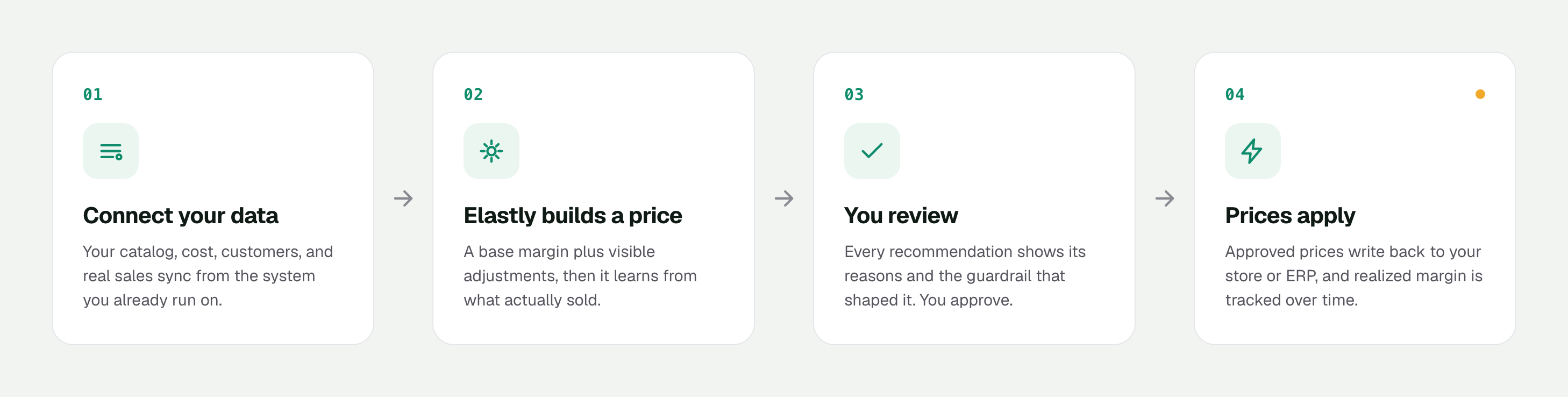
From your data to a live price, with you in the loop at every step.
How a price gets built
Elastly does not guess a number. It builds one, a step at a time, and every step is visible. It starts with a base margin for the product’s category. Then it adds adjustments for the things that genuinely change the right price: who the customer is, where they are, what terms they are on, whether your cost is trending up, and how demand is moving. Each adjustment is a labelled step with its own size, so a price is a stack of reasons you can read, not a black box. Then your guardrails clamp it. A margin floor it can never dip below, an optional ceiling, a limit on how far a price can move at once, and your rounding. The recommendation tells you which guardrail had the final say.This is additive margin stacking, not elasticity modelling. Elastly does not try to fit a demand
curve to your catalog. It starts from a margin you chose and adjusts it for reasons you can name.
It learns from what actually sold
When a quote is won or lost, Elastly nudges the margin for that customer and product by a small, careful amount. Sell more, and the pricing gets sharper. The learning is bounded by the same guardrails as everything else, so it can tighten your pricing without ever surprising you.Nothing changes until you say so
Elastly queues only the products whose price should move. Each one arrives with its reason and the drivers behind it. You approve or reject, or you let prices apply on their own once they are safely inside your guardrails. Every change is recorded, so you can track realized margin over time.Start here
Quickstart
Connect a source, set your guardrails, and get to your first recommendation.
Connectors
How NetSuite, Shopify, BigCommerce, and WooCommerce sync into canonical data.
Pricing strategies
How the margin stack is assembled, and how strategies shape it.
Guardrails & rules
The limits a recommended price can never cross.
Explainability
What travels with every recommendation, and how to read it.
API reference
Ask for a customer- and quantity-specific price, with the reason stack attached.