

The order a price is built in
What Elastly derives
Signals read from the order and your data, like a rising cost or a large order.
Your base margins
These are the margins you configure. Category margin is the starting markup over cost; the rest are signed adjustments on top.The most specific setting wins. For any one margin, Elastly picks a single value using this
order: an exact value, then category and brand together, then brand, then category, then segment,
then country, then region, and finally your global default. Setting a margin for one category does
not stack with your global default, it replaces it.
What Elastly derives
These steps come from the order in front of it and the data it has synced. Each is off until you configure it, and each contributes only when its signal is actually present.A worked example
Every step is a signed adjustment on cost, and they add up to the target margin. The numbers here are illustrative.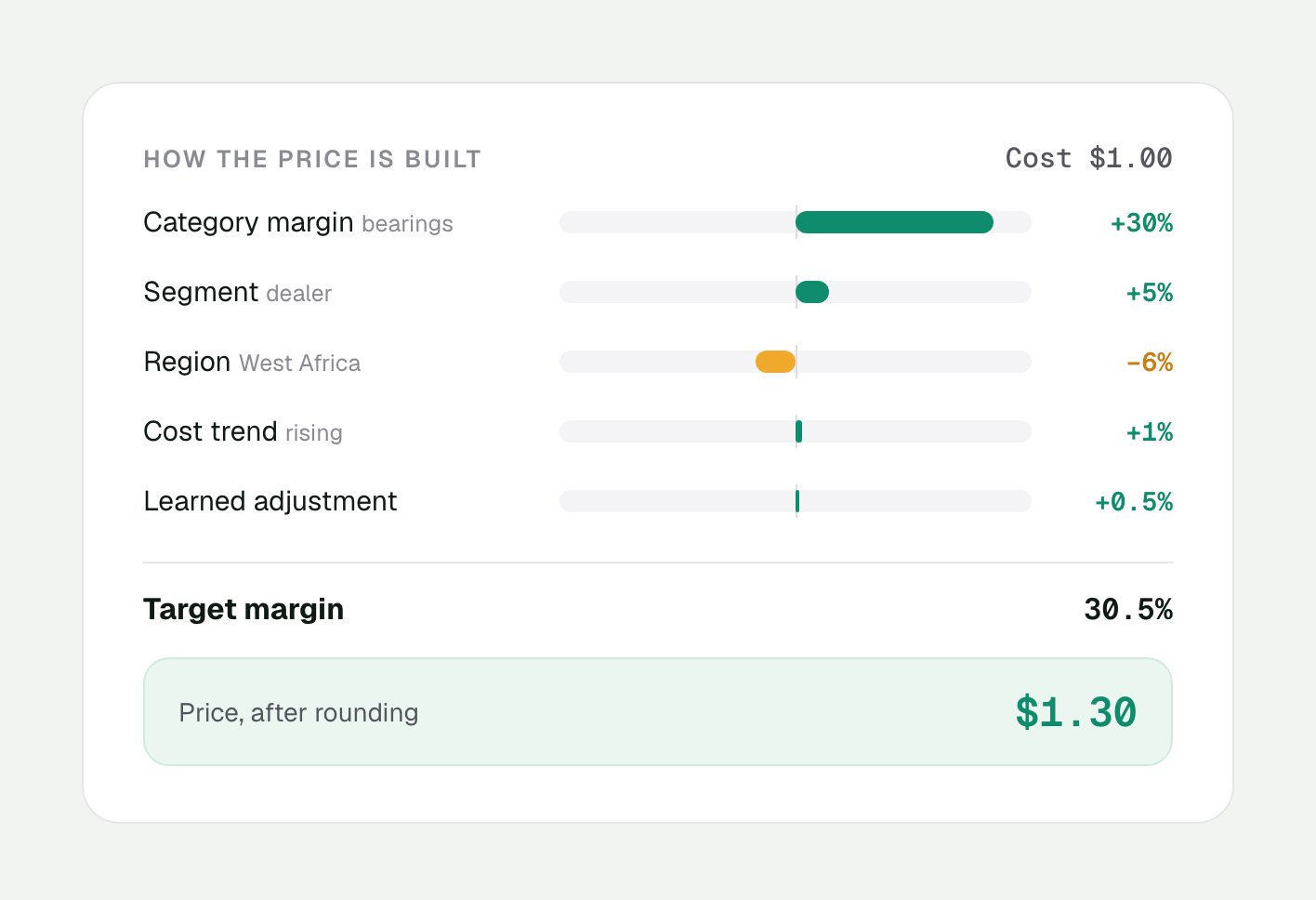
Each step is one signed adjustment. They add up to the target margin, then the price is rounded.
What a strategy is
A strategy is a rule you add on top to shape pricing for a set of products. It has three parts: scope (which products and customers it covers), conditions (when it should act), and an action (what to do).Actions
Match, beat, and premium need a competitor source connected before they can act.
Conditions
A strategy acts only when its conditions hold. You can test current margin, last margin, order quantity, payment terms, delivery speed, stock state, days of inventory, price band, whether the product is a known value item, the gap to a competitor, how many sellers are on it, demand, and elasticity. You can also test any custom attribute you have mapped.Scope
Scope narrows a strategy to the products and customers you mean: brand, price band, price, current margin, last margin, known value items, channel, region, country, and payment terms, plus your own mapped attributes.A strategy can tighten, never loosen. A strategy can make four guardrails stricter for its
products: the margin floor, the margin ceiling, rounding, and how far a price may move from its
last one. It can never make any of them looser, and it cannot touch your other guardrails at all.
See Guardrails & rules.
It learns from real sales
When a quote is won or lost, Elastly nudges the margin for that customer and product by a small, capped amount. One order never swings a price, but thousands steer it. The steps are deliberately small:
Elastly also keeps track of the highest margin a customer has accepted and the lowest they have
rejected, and holds the learned offset between the two. It squeezes toward what you know rather than
guessing past it.
It learns at the most specific level it can
Learning is keyed to the narrowest scope with evidence behind it:- Customer and item
- Customer and subcategory
- Segment and subcategory
- Segment and category
A loss only counts as “too expensive” if you could have supplied it. If the item was out of
stock when the quote was lost, the loss had nothing to do with price, and Elastly ignores it
completely rather than lowering your margin for it.